Amin Ur Rashid for making agriculture export-oriented thru safe food production

Fisheries, Livestock and Agriculture Minister Mohammad Amin
Ur Rashid today (4 June) emphasised the need to ensure safe food production and
improve the quality to tap into the vast global market.
"Our primary objective is to
make the agricultural sector export-oriented. If we can achieve this, we will
be able to permanently strengthen the country's economy," the minister
said.
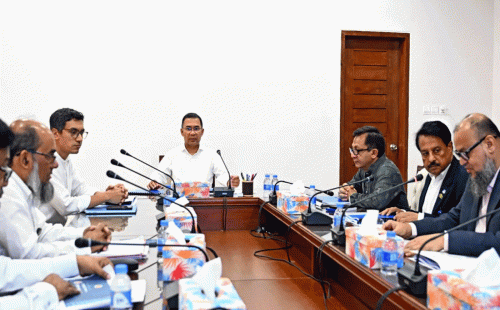
He made the remarks while speaking
as the chief guest at the 90th (special) meeting of the Pesticide Technical
Advisory Committee (PTAC), held at the auditorium of the Bangladesh
Agricultural Research Council (BARC) in Farmgate here.
Highlighting that nearly 75 percent of the country's population depends on
agriculture, the minister said several countries, including Japan, have
expressed interest in importing agricultural products, especially vegetables,
from Bangladesh. However, he pointed out that international food safety
standards remain the primary challenge.
Expressing concern over the current
pesticide approval and evaluation system, the minister urged the technical
committee to adopt comprehensive testing methods.
"Pesticide testing should not merely focus on whether a chemical kills
pests. Before granting approval, we must strictly evaluate its residual effects
on human health, soil quality, and the environment," he said.
The minister stressed the importance
of strengthening the Bangladesh Food Safety Authority to make it an
internationally recognised body.
"This authority will
eventually serve as the backbone of our agricultural export trade," he
added.
He urged the committee members and
agricultural experts to formulate effective, long-term policies to regulate the
import of pesticide raw materials, monitor distribution channels, and ensure
strict quality control at the field level.
The minister assured that the
government is fully prepared to implement the realistic recommendations and
policy guidelines provided by the experts to ensure safe food for both domestic
consumers and the international market.
Guest of honour of the meeting and
Secretary of the Ministry of Agriculture Rafiqul I Mohamed said, "We must
ensure that the policies and regulations we formulate for pesticides are
realistic and strictly enforceable, rather than just remaining as 'paper laws'
that sound good but fail on the ground."
"The unregulated and excessive
use of chemical fertilizers and pesticides is directly contributing to the
alarming rise of chronic illnesses such as cancer, kidney diseases, and
diabetes," he added.
He said, while the country is
spending massive amounts of money on medical treatments and pharmaceuticals, we
are failing to address the root cause of these health hazards, which is
chemical contamination in our food chain."
He also said due to toxic chemical
runoff from agricultural lands, the water bodies and rivers are being
destroyed. Rivers that once thrived with aquatic life are now completely devoid
of fish, and the water of major rivers like the Buriganga has become highly
toxic.
"Our primary failure lies in
the lack of field-level implementation, inspection, and monitoring. We must
strengthen our monitoring mechanisms so that farmers are protected, and the
public is saved from the devastating health impacts of toxic chemicals,"
he added.
Executive Chairman of the
Bangladesh Agricultural Research Council (BARC) Md. Abdus Salam presided over
the programme. Among others, university teachers, researchers, and government
officials were present at the meeting.