Govt plans higher value-addition rules for exports

Exporters may need to add more value – at least by 50% – to
products as the government drafts a new policy with a stronger push for reduced
reliance on imported inputs and the development of backward linkage industries.
One
of the biggest changes proposed in the draft Import Policy Order 2026-2029,
seen by TBS, is a sharp increase in the minimum value-addition requirement for
garment exports made from imported raw materials.
Officials
say if an exporter fails to meet the requirement, it will not receive any cash
incentive and the duty benefits on raw material imports.
For
children's garments, the minimum value addition requirement may double from 15%
to 30%. For all knit and woven garments made from cotton and man-made fibres,
the threshold could rise from the existing 20% to 30%.
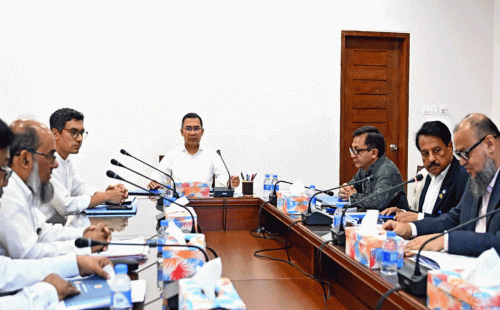
A stakeholder meeting is scheduled for today, where Commerce Minister Khandakar
Abdul Muktadir is expected to discuss the draft policy with industry
representatives ahead of finalisation.
If
approved and implemented, the comprehensive new trade directive will remain
effective until 31 December 2029.
Higher value addition
requirements
Under
the current import policy, there is no minimum value-addition requirement for
the export of goods, except for knitwear, woven garments, and children's
clothing.
However, under the draft policy, stricter value addition thresholds have also
been proposed for several other export sectors. Underwear and other synthetic
fibre-based specialised garments may be required to meet at least 40% value
addition.
Footwear, including leather and non-leather products, may be subject to a 30%
requirement. Ship exports could be subject to a 40% threshold, while wooden
furniture exports may be required to achieve 50% value addition.
The
draft policy also proposes a ban on importing knitted fabrics, a move that has
drawn criticism from industry leaders who argue that domestic production is
insufficient to meet export demand.
Exporters warn against higher
thresholds and fabric bans
Bangladesh
Garment Manufacturers and Exporters Association President Mahmud Hasan Khan
told TBS while a 30% value addition is achievable for the knitwear sector, it
remains entirely unrealistic for the woven garment segment under present market
conditions.
Echoing
these concerns, Bangladesh Knitwear Manufacturers and Exporters Association
President Mohammad Hatem said while the government's targeted thresholds might
be feasible in isolated cases, the prevailing international market dynamics
make them impossible to implement across the board.
Apparel
leaders heavily criticised the clause in the draft policy that seeks to enforce
a blanket ban on the import of knit fabrics.
The
BGMEA president argued that Bangladesh must maintain open channels to import
specialised knit fabrics that are not locally manufactured, warning that
failing to do so would severely cripple export competitiveness.
Adding
to this, Hatem explained that halting knit fabric imports would require massive
immediate investments in the domestic dyeing sector alongside guaranteed gas
supplies.
The
BKMEA president warned that banning fabric imports would derail crucial product
diversification into high-value knitwear when "the government is currently
unable to ensure consistent gas distribution and the broader economic climate
is unsuited for heavy capital expenditure."
Preventing money laundering
Md
Hafizur Rahman, former director general of the WTO Cell under the commerce
ministry, told this newspaper that the value addition rate might be increased
to prevent exporters from repatriating lower export proceeds as a means of
money laundering, despite exporting at higher prices. "At the same time,
encouraging exporters to use local materials could also be an objective."
However,
he noted that since Bangladesh's primary goal is job creation, raising the
minimum threshold for value addition is not logical. "This could hamper
exports from smaller factories, which would ultimately shrink employment
opportunities."
Hafizur
added, "Vietnam does not have such stringent value addition requirements.
Many small factories in that country import from China, add a minimal amount of
value, and then export."
Changes in import entitlement
rules
While
the import of used vehicles, motor cars, passenger cars, and trucks older than
five years remains prohibited as before, the draft import policy proposes to
allow the import of electric vehicles that are up to 10 years old.
The
policy also proposes changes to export-linked import entitlements under
free-of-cost arrangements. The existing entitlement of up to 50% of the
previous year's export value for garments, woven and children's clothing would
remain unchanged. However, for man-made fibre products and synthetic underwear,
the limit may be increased from 50% to 70%.
For
footwear and leather goods, the proposed import entitlement is 60% of the
previous year's export value. Ship imports would be allowed up to 60% of the
export letter of credit value. Furniture-related import limits have been
proposed at 40% for wooden furniture, 20% for fabric-based furniture and 10%
for parts and accessories.
Trade facilitation and
sector-specific reforms
The
draft order removed the existing $5,00,000 ceiling on imports under sales or
purchase contracts without opening letters of credit, expanding flexibility for
businesses.
It
also proposes eliminating fixed time limits for shipment after opening letters
of credit, which currently stand at 24 months for machinery and nine months for
other goods.
The
threshold for personal imports by non-registered importers has been proposed to
be doubled from $10,000 to $20,000.
For
expatriate Bangladeshis, the duty-free limit for sending goods to family
members has been proposed to be raised from Tk10,000 to $1,000.
Export-oriented
garment manufacturers may also see an increase in the annual import quota for
samples, rising from 1,500 to 3,000 items per category. Similar increases have
been proposed for the footwear and leather industries, while tanneries may see
their sample import limit rise from 300 to 3,000 pieces.
Policy alignment and
geopolitical provisions
Although
the draft did not explicitly refer to the United States trade agreement, it
allowed reduced tariff imports under certificates of origin linked to
preferential and free trade agreements with various countries and regions.
The
draft introduced a direct prohibition on imports from Israel, stating that no
goods produced in or originating from Israel, nor cargo carried on
Israeli-flagged vessels, will be eligible for import.