Govt increases fuel supply as chaos lingers on
A day after hiking fuel prices, the government
has announced a 10-20% increase in diesel, octane and petrol supplies from
today to ease the shortages that kept motorists waiting in long queues for
hours in Dhaka and elsewhere as of yesterday.
In a notification last night, the Energy
Division said the distribution companies under the Bangladesh Petroleum
Corporation (BPC) will sell 13,048 tonnes of diesel, 1,422 tonnes of octane and
1,511 tonnes of petrol per day from 20 April. This marks a 10% increase for
diesel and petrol, and 20% for octane.
"Considering the present demand for fuel
oils, companies under the BPC have been instructed to sell at the increased
rates to keep up the supplies at dealers' and consumers' levels," reads
the notification.
The government raised the price of octane by
Tk20 per litre, petrol by Tk19 and diesel by Tk15, effective from yesterday.
Earlier in parliament yesterday, Energy and
Mineral Resources Minister Iqbal Hasan Mahmud Tuku blamed panic buying,
stockpiling and black market activity for the shortages at filling stations.
He said there is no shortage of fuel in the
country, but that an artificial crisis is being created.
Despite a sharp increase in fuel prices aimed at
reducing the subsidy burden, motorists across Bangladesh continued to face long
queues at filling stations and shortages yesterday, with no sign of an
improvement in supply.
Many motorists had expected the price increase
to be followed by higher supplies from depots to petrol stations, easing the
shortages that have persisted for weeks. Instead, the situation remained
largely unchanged.
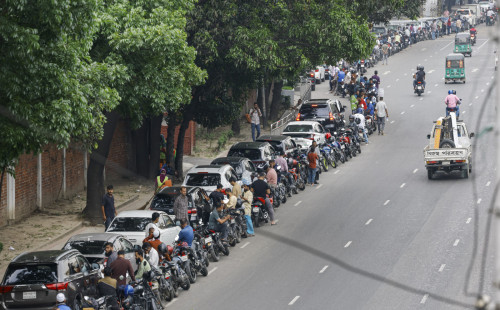
Drivers and motorcyclists in Dhaka and elsewhere
in the country were still waiting for hours at filling stations to obtain fuel.
At some filling stations, motorcyclists who
joined queues at midnight on Saturday were only able to buy fuel yesterday
afternoon. Even then, some said they had not been allowed to fill their tanks.
Measures taken by the Energy Division to tackle
hoarding and black market sales, including appointing tag officers at filling
stations, forming monitoring teams at district and upazila level and conducting
mobile court operations, have so far failed to improve the situation.
Energy Adviser to the Consumers Association of
Bangladesh (CAB) M Shamsul Alam said the ministry had created a narrative that
"fuel reserves are overflowing and that there is insufficient storage
space".
"Yet people are standing on the streets for
hours without getting fuel. The Energy Division, the BPC, the Competition
Commission, the Directorate of National Consumer Rights Protection and the law
enforcement agencies are all standing like wooden puppets. There are no words
to describe this," he told TBS.
Shamsul Alam said the public could have accepted
the difficulties if the government had acknowledged that supply is being
disrupted by the Middle East conflict, the dollar shortage and uncertainty over
the Strait of Hormuz.
"Instead, the ministry has created the
opposite narrative and is not even admitting there is a fuel shortage. That is
proof of the government's serious inefficiency and inability to control the
supply chain," he said.
Asked whether fuel supplies would be increased
after the price rise, Energy and Mineral Resources Division spokesman Monir
Hossain Chowdhury said, "We are often supplying more than the allocated
amount. But unless panic buying stops, the situation will not return to
normal."
Sajjadul Karim Kabul, president of one faction
of the Petrol Pump Owners' Association, said depot supplies had not increased
despite the higher prices.
"What is the point of raising fuel prices?
The crisis will not end unless supplies increase. If they supplied fuel at full
capacity for one week, everything would calm down," he said.
Kabul said officials appear worried that the
Strait of Hormuz could be closed again and are therefore reluctant to release
more fuel.
"We do not even know whether the government
has the fuel. They keep telling the press that reserves are at their highest
level in 50 years. If there are reserves, then release the fuel," he said.
Kabul said his 13,500-litre tanker had received
only 9,000 litres from the depot and that the same situation had continued for
the past three days.
The government's position also drew criticism in
parliament.
Rumin Farhana, member of parliament for
Brahmanbaria-2, accused the government of misleading the public.
Speaking on a point of order yesterday, she
said: "The government keeps saying there is no fuel shortage, but the
reality is completely different. There are queues stretching for three
kilometres. Drivers are waiting until midnight and still not getting fuel. If
there is no crisis, why are there such long queues? Why has the government
increased fuel prices?"
Fahmida Khatun, executive director of the Centre
for Policy Dialogue, told this newspaper that the price increase had been
necessary because the government could no longer bear the cost of rising
international fuel prices caused by supply disruptions.
"Consumers now want access to fuel without
difficulty. The government must ensure adequate supply in order to normalise
the situation," she said.
Countrywide paralysis
The shortage is not confined to the capital,
according to TBS correspondents. Reports from Savar suggest that 75% of filling
stations lacked octane and petrol by Sunday morning. Local officials claimed
that while 68% of pumps had diesel, the concentrated demand on a few functional
stations created a sense of panic.
The crisis has also hit the transport sector in
Bogura, where goods-carrying trucks are unable to secure sufficient diesel, and
in Barisal and Brahmanbaria, where pump owners report receiving no clear
timeline from depots regarding when normal supply will resume.
At some stations, such as the SI Chowdhury
Filling Station in Savar, managers reported receiving only one-third of their
usual weekly octane allocation.