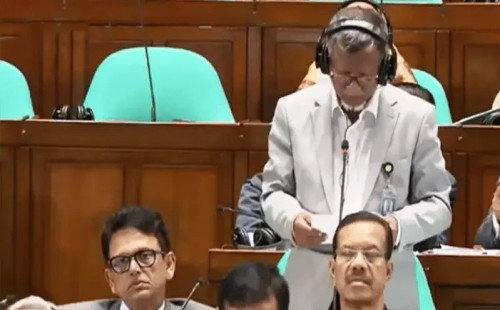
IMF wants all tax exemptions, subsidies gone in next budget

The International Monetary Fund (IMF) has
advised Bangladesh to withdraw all forms of tax exemptions, covering income
tax, value-added tax (VAT), and customs duties, starting from the next national
budget (FY2026-27).
Alongside ending tax exemptions, the IMF has
also pressed for the reduction of supplementary duties imposed at the import
stage.
The recommendation was raised during discussions
at the Annual and Spring Meetings of the International Monetary Fund and the
World Bank Group held in Washington, DC, sources at the National Board of
Revenue (NBR) said.
A senior NBR official, speaking on condition of
anonymity, told The Business Standard, "At the ongoing meetings, the IMF
asked that all types of tax expenditure be withdrawn."
Another Bangladeshi representative in Washington
said the IMF was urging the government to withdraw a large share of tax
exemptions in the upcoming budget.
An official from the Bangladeshi delegation
attending the IMF board meetings told TBS, requesting anonymity, that the
lender had taken a positive stance on Bangladesh's request for additional
budget support to help meet rising fuel import costs.
However, the size of the potential new loan and
its conditions have yet to be finalised.
The official said the Bangladeshi delegation,
led by Finance Minister Amir Khosru Mahmud Chowdhury, held separate meetings
with IMF officials seeking the release of about $1.53 billion by June,
including overdue instalments under the existing loan programme as well as
fresh financing.
"During the discussions, the IMF maintained
a firm position on implementing two key conditions of the main loan
agreement," the official said.
"The conditions include cancelling all tax
exemptions alongside tariff rationalisation, and withdrawing energy subsidies
for gas and electricity while bringing low-income groups under social safety
net programmes. If these conditions are implemented, the IMF is ready to
release the funds within the current fiscal year," the official added.
The official added that the IMF also reiterated
its call for Bangladesh to move towards a fully market-based exchange rate.
Officials from the Bangladesh Bank told the IMF
that the country intends to gradually move towards a fully market-driven
exchange rate in order to maintain economic stability.
The meetings, which began on 13 April, are
scheduled to conclude on 18 April. Senior officials from the finance ministry
are attending alongside NBR chairman Abdur Rahman Khan.
Wide range of exemptions currently in place
The government currently provides VAT, tax and
import duty exemptions on most agricultural and food products. Some goods also
enjoy partial exemptions.
Essential services such as education and
healthcare also benefit from tax relief. Exemptions are also available for
certain essential sectors, including fuel and electricity.
In addition, to encourage investment and job
creation, the government offers income tax, VAT and customs duty exemptions for
investors in export processing zones, economic zones and hi-tech parks.
Export-oriented industries also receive tax incentives.
Remittances are fully exempt from tax to
encourage overseas earnings. Bangladesh received more than $30 billion in
remittances in the 2024-25 fiscal year, while export earnings stood at nearly
$50 billion.
Tax exemptions – defined as the difference
between standard tax or VAT rates and the amount actually collected due to
concessions – represent a large fiscal cost.
According to the latest data from the NBR, tax
exemptions in income tax, VAT, and customs duties amounted to about Tk2.66 lakh
crore in the 2022-23 fiscal year. In comparison, total government revenue
collection in that year stood at Tk3.25 lakh crore.
In 2022, during the tenure of the Awami League
government, Bangladesh secured a $4.7 billion loan programme from the IMF. Of
this amount, roughly $3 billion has already been disbursed in instalments.
However, the lender later suspended further
disbursements toward the end of the interim government's tenure, citing slow
progress in implementing reform measures under the programme.
Negotiations over the release of remaining funds
resumed after a new government led by the BNP took office.
Experts warn against abrupt withdrawal
Economists say that while reducing tax
exemptions is necessary, eliminating them entirely may not be feasible in the
short term.
They warn that withdrawing exemptions across the
board in line with IMF recommendations could increase tax burdens in several
sectors. This could affect both wealthy and low-income groups directly and
indirectly, potentially fuelling inflation.
Mustafizur Rahman, distinguished fellow at the
Centre for Policy Dialogue (CPD), said removing all exemptions within a year
would not be reasonable.
He warned that such a move could undermine the
confidence of both local and foreign investors in government policy.
"The government should plan to withdraw
these benefits through sunset clauses, which the NBR has already begun
implementing," he said. "However, the entire exemption framework
should first be reviewed before decisions are made."
Mustafizur noted that some sectors have enjoyed
tax exemptions and incentives for more than 50 years.
"In some cases, individuals or groups have
obtained exemptions through influence. These should not continue indefinitely,"
he said, adding that exemptions should be streamlined by lowering tax or VAT
rates.
Towfiqul Islam Khan, an additional director at
CPD, said the government needs stronger fiscal discipline and should align
incentives with the country's graduation plan from the UN's least developed
country status.
"Tax exemptions should be reduced gradually
and according to a clear plan, particularly in sectors such as poultry,
fisheries, agriculture and remittances," he said. "The principle
should be simple – those who earn should pay tax."
Risks of abrupt policy shifts
Snehasish Barua, managing director of SMAC
Advisory Limited, warned that an abrupt withdrawal of tax exemptions could
trigger economic shocks.
"The sudden withdrawal of tax exemptions
risks triggering an acute macroeconomic shock. Such an abrupt policy shift
could destabilise capital markets, cripple RMG export competitiveness and fuel
immediate cost-push inflation," he told The Business Standard.
"Moreover, it threatens to deter foreign
direct investment, stifle the burgeoning digital economy and spark widespread
corporate compliance crises."
He added that investors allocate capital based
on established statutory frameworks and that removing incentives without a
transition period could erode trust in fiscal policy.
"To navigate this necessary reform, a
phased and predictable transition is vital. The government must rigorously
audit all active tax exemptions to guarantee they deliver tangible strategic
value," he said. "Moving forward, every tax expenditure must be tied
to specific, measurable criteria, undergo stringent annual reviews and be bound
by a mandatory sunset clause."
Govt signals shift in approach
While indicating a move away from the blanket
tax exemptions granted by previous governments, the new administration has said
it plans to introduce performance-based incentives.
Speaking to reporters after a meeting at the NBR
on 29 March, the prime minister's adviser on finance and planning, Rashed Al
Mahmud Titumir, said, "The target would be met by accelerating economic
activity through higher investment and employment, alongside structural and
policy reforms; curbing tax evasion and fraud; and shifting from blanket tax
exemptions and rebates to performance-based incentives."
According to NBR data, VAT exemptions currently
apply to several products and raw materials under 53 different categories, most
of which involve agricultural and food items.
Nine essential services related to basic needs –
including social welfare, cultural activities, financial services, transport
services and certain personal services – are also fully exempt from VAT.
The standard VAT rate currently stands at 15%.
Under the third schedule of the VAT law, reduced
VAT rates are applied at different stages of production and supply for several
goods.
At the import stage, many goods and services
face substantial supplementary duties, in some cases reaching as high as 500%.
Experts say such high supplementary duties
create uneven competition in the market and increase costs for consumers. The
IMF has also urged Bangladesh to reduce these duties and make the tariff
structure more rational.