Law change paves way for former owners to reclaim distressed banks

An amendment to the Bank Resolution Ordinance
has created a legal pathway for former owners to reclaim control of distressed
banks currently under resolution.
The amendment specifically impacts the ongoing
merger of five distressed institutions – First Security Islamic Bank, Social
Islamic Bank, Union Bank, Global Islamic Bank, and Exim Bank – which were being
consolidated into Sammilito Islami Bank under the previous interim government's
reforms.
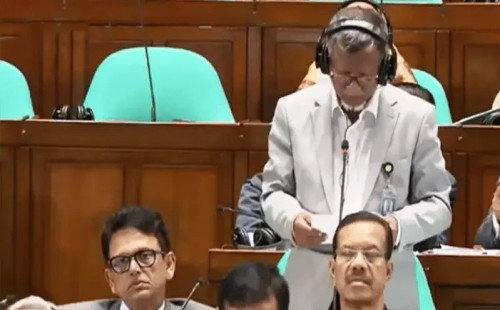
Under the new provision passed in the parliament
on Friday, former owners can apply to the Bangladesh Bank to reacquire their
shares, assets, and liabilities, potentially leading to the dissolution of the
newly merged entity.
Of the five banks, four were controlled by the S
Alam Group chairman and controversial businessman Saiful Alam, while Exim Bank
was under the control of Nassa Group Chairman Nazrul Islam Mazumder.
Experts have criticised the amendment, warning
that it undermines the credibility of banking sector reforms and effectively
allows those responsible for financial distress to regain control.
Conditions for ownership recovery
The government amended the ordinance by
introducing Section 18A. Under the new regulations, applicants seeking to
regain control must submit a formal undertaking. This includes a pledge to
repay all funds as determined by the government or the central bank, provide
fresh capital, and restore financial solvency.
They are also required to settle all liabilities
to depositors and creditors, pay outstanding taxes, and reconstruct risk
management and compliance frameworks.
Financial terms for the recovery include an
initial pay-order of at least 7.5% of the total determined amount within three
months of approval. The remaining 92.5% must be paid over two years with a 10%
simple interest rate.
Following approval, the Bangladesh Bank will
supervise the institution for two years before a special committee conducts a
final investigation into compliance, with the option to revoke approval in case
of failure.
Government defends 'market solution'
Finance Minister Amir Khosru Mahmud Chowdhury
described the move as a "market solution" aimed at ensuring fairness,
equity, and investment protection.
He explained that the government has already
invested approximately Tk80,000 crore into weak banks and may need another Tk1
lakh crore – a financial burden he described as unsustainable in the current
global economic climate.
"This new arrangement places the obligation
of recapitalisation and liability settlement on the applicants, reducing the
pressure on the government and the Deposit Insurance Fund," the minister
stated.
He added that the option remains open to any
suitable party deemed fit by the central bank, not just former shareholders,
and argued that keeping banks operational preserves asset value and protects
employment.
Experts warn of 'credibility destruction'
The move has drawn sharp criticism from experts
who were involved in drafting the original resolution framework.
Zahid Hussain, former lead economist of the
World Bank's Dhaka office and a member of the interim government's banking
reform task force, warned that the amendment destroys the credibility of the
reform process.
"A clear roadmap has been provided for
former owners to re-occupy banks that were distressed due to their own
mismanagement and the siphoning of funds," he told The Business Standard.
The economist estimated that for the five merged
banks, the total required payment would be roughly Tk35,000 crore. He expressed
concern that the terms are so lenient that former owners could easily pay the
initial 7.5% and borrow the remainder from the banking sector itself.
Uncertain future for Sammilito Islami Bank
According to Zahid, the future of Sammilito
Islami Bank now rests entirely on the discretion of the returning owners.
"If they choose to operate the five banks as separate entities once again,
the merged institution will cease to exist."
He noted that the move sends a signal to the
market that individuals responsible for financial irregularities can still
return to positions of ownership.