Industry loses share as services race ahead in economy
Small
businesses and service providers, from retail shops to transport and personal
services, are expanding more rapidly than formal manufacturing units, prompting
economists to question the sustainability of the country’s long-term growth.
Industrial
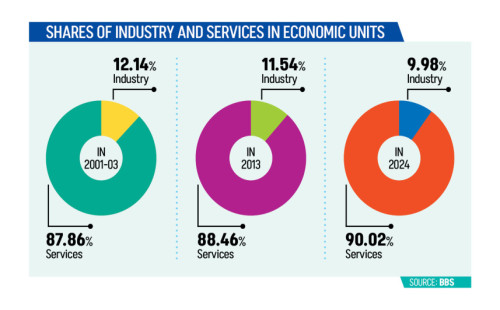
enterprises now account for just under 10 percent of all businesses, down from
more than 12 percent two decades ago, according to the 2024 economic census
conducted by the Bangladesh Bureau of Statistics (BBS).
In
contrast, service businesses dominate the economy, making up more than 90
percent of economic units.
In
absolute terms, industrial units grew by 159 percent between 2001 and 2024,
reaching around 11.7 lakh. Service businesses, however, surged by more than 223
percent over the same period, bringing the total number of economic units to
1.17 crore.
Employment
followed a similar trend. Jobs in industry rose to nearly 94 lakh in 2024,
while the service sector absorbed far more workers, with employment reaching
over 2.12 crore.
Economists
say if this pattern continues, it could dent productivity growth.
“This is
what economists call premature deindustrialisation, a pattern seen in many
developing countries,” said Kazi Iqbal, research director at the Bangladesh
Institute of Development Studies (BIDS).
“Manufacturing
usually drives productivity gains and absorbs labour from agriculture. When
services expand faster than industry, the economy grows, but not as efficiently
or sustainably,” he said.
The
economist explained why the distinction between industry and services matters.
According
to him, moving workers from agriculture to manufacturing increases productivity
and incomes more than a direct shift to services.
“Services
create jobs, yes, but the overall growth impact is smaller,” said Iqbal.
Anwar-ul
Alam Chowdhury, president of the Bangladesh Chamber of Industries, said that
some local sectors have reached saturation. To sustain both economic growth and
employment, the country must become a diversified manufacturing hub with a
stronger focus on labour-intensive industries.
The
business leader said that while Bangladesh’s development has heavily relied on
the industrial and RMG sectors, employment growth continues to come mainly from
labour-intensive industries such as RMG and light engineering.
He said
high-investment sectors, including steel, cement, machinery, and chemicals,
generate fewer jobs because of automation, which is increasingly present in
garment production as well.
The RMG
sector alone contributes about 25 percent to manufacturing output, rising to 40
percent if textiles are included. Other industries account for the remaining 60
percent, but automation limits their potential for employment creation.
Chowdhury
said that even a $50 million investment in textiles may generate only 500 to
1,000 jobs, whereas the same investment in RMG could employ between 5,000 and
8,000 workers.
“Labour-intensive
sectors like leather and light engineering are crucial for job creation.
Without expanding into these industries, employment growth will remain
constrained,” he said.
The 2024
census also shows a slowdown in business expansion.
Between
2013 and 2024, the total number of economic units rose by 50 percent, lower
than the 111 percent growth recorded in the previous decade. Micro and cottage
enterprises continue to dominate, comprising 96 percent of all units, and
nearly two-thirds of these are located in rural areas.
The data
point to a deeper structural shift in the economy. Growth in small and informal
service businesses is outpacing manufacturing, which limits the country’s
capacity to diversify exports and create higher-quality, well-paid jobs.
“Ideally,
manufacturing should be the engine that absorbs labour from agriculture and
drives productivity,” said Iqbal. “But what we are seeing is that services are
expanding faster, without industry growing at the pace it should.”
The census
also identifies financing challenges for businesses.
According
to it, nearly 86 percent of economic units face capital shortages, making
access to finance the most pressing constraint.
About a
third of businesses reported difficulties obtaining loans. Other common
concerns include infrastructure gaps, rising production costs, and shortages of
skilled labour.
Around 8
percent of businesses struggle with consistent electricity and fuel supply,
while smaller shares reported issues with marketing and access to raw
materials.