All attackers of July activists to face action
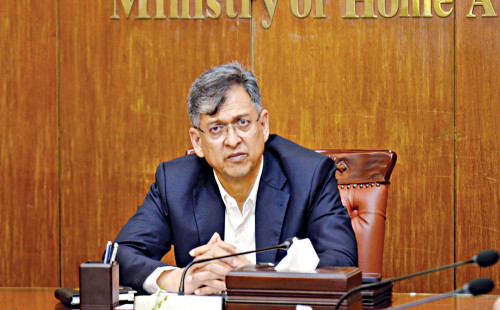
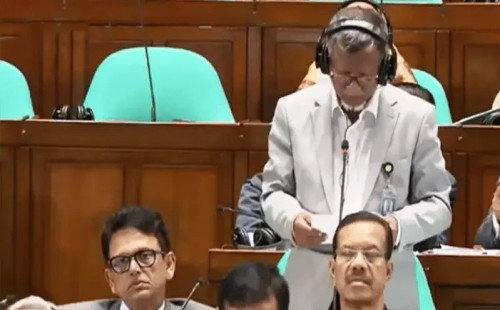
Home Minister Salahuddin Ahmed said those involved in armed
attacks against activists of the July uprising would be treated as criminals,
irrespective of their uniform, and assured proper investigation of all cases
and protection for July fighters.
He made the remarks while answering two separate
supplementary questions in yesterday’s parliamentary sitting.
To a question from BNP MP Zainul Abedin Farroque, Salahuddin
said, “Those who carried out armed attacks against July fighters and ordinary
people -- whether they wore the uniform of any force, or were [from] Jubo
League, Chhatra League -- whoever they were, they are all criminals. Cases have
been filed against them.
“If not, you may file them, and all cases will be properly
investigated. The judiciary is responsible for delivering judgement.”
National Citizen Party MP Akhtar Hossen asked whether the
home ministry would take departmental action, beyond judicial investigations,
against police officers involved in killings and torture over the past 16
years, particularly during the uprising, adding that the Awami League was using
the frame of “police killings” to “create disorder”.
In response, the home minister said July fighters are
legally and constitutionally protected under the July National Charter, and
added that an ordinance issued during the interim government to safeguard them
has been placed before parliament and is expected to be passed as a bill with
consensus.
“The Awami fascist groups are demanding justice for killings
on social media. As I said before -- if that is the case, then freedom fighters
too would have to be tried for killing Razakars, if someone now files a case.”
He noted that specific cases have been filed over police
killings. “Some are being tried at the International Crimes Tribunal, while
others are under the Penal Code in regular courts. Investigations are ongoing,
and some charge sheets have already been submitted,” he said, adding that
courts will conduct trials independently, without government interference.
Responding to another supplementary question from BNP MP
Abul Kalam Azad Siddiqui, Salahuddin said some politically motivated and false
cases were withdrawn during the interim government. “After BNP came to power,
one of its first tasks was to withdraw false cases. Cases against political
activists, journalists, and people from various professions were reviewed and
withdrawn upon application.”
Noting that district-level committees were formed under the
leadership of district magistrates, he said, “Politically motivated cases filed
between 2009 and 2024 can be submitted for withdrawal through these committees,
which review and forward them to the ministry.
“Based on recommendations from a committee led by the law
minister, cases are then withdrawn under Section 494 of the Criminal Procedure
Code.”
‘ROAD BLOCKADES WON’T BE ALLOWED’
The home minister, responding to another question, said,
“The tendency to block highways and roads to press demands, which was seen
during the interim government and in some cases inspired by its weakness, will
never be allowed by us.”
He said that as part of the democratic process, demands will
exist, and petitions can certainly be submitted to the relevant authorities,
ministries, or departments in that regard.
“To build public opinion, seminars and symposiums can be
organised, and if necessary, those demands can be expressed through public
gatherings.
“The right to association, the right to speak -- we will
ensure these. That can be done. It is democratic culture,” he said, adding that
all must move away from the tendency of pressing demands through mobs.
Responding to a question by Brahmanbaria-2 MP Rumeen
Farhana, Salahuddin reiterated, “There will be no kind of mob culture in
Bangladesh.”
Asking what steps the government would take to stop mob
culture, Rumeen said that for 15 long years of Awami League rule, there was a
culture of enforced disappearances, extrajudicial killings, and torture in
custody.
“Then during the interim government, we witnessed mob
culture. From September 2024 to January 2026, statistics show that more than
250-300 people were killed after falling prey to mobs.”
To this, Salahuddin said, “I do not have that exact
statistic. What we have is an estimate…. Since taking on this responsibility,
incidents resembling mob violence -- though not exactly mobs -- have occurred
during this period. Because here we must distinguish definitions.
“The definition of mob is different. When it is a specific
crime, the definition of crime is different.”