Shrimp industry at critical juncture
Speakers at a policy dialogue said Bangladesh's shrimp industry
is at a critical crossroads and requires urgent, strategic policy reforms to
reinstate its global competitiveness after years of decline.
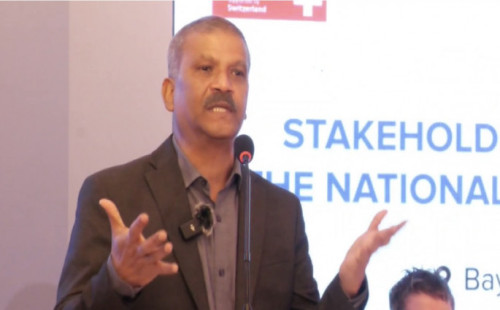
The Policy Research Institute of Bangladesh (PRI), in collaboration with the
Bangladesh Frozen Foods Exporters Association (BFFEA), organised the dialogue
titled "Transforming Policy Support for Reviving Bangladesh's Shrimp
Sector" at InterContinental Dhaka on Wednesday night.
Dr Bazlul Haque Khondker, research director at PRI, presented
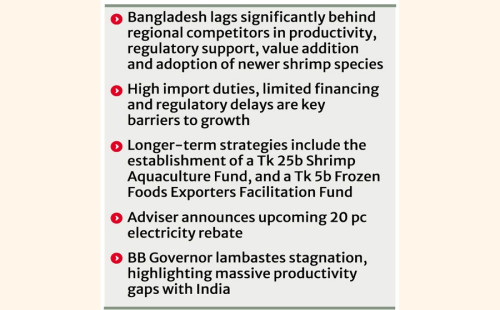
the keynote paper, noting that Bangladesh lags significantly behind regional
competitors such as India, Vietnam and Indonesia in productivity, regulatory
support, value addition and adoption of newer shrimp species, including
Vannamei.
While neighbouring countries provide sector-specific incentives
-- including low-interest financing, bonded warehouse facilities, insurance
schemes and subsidies -- Bangladesh's policy support system remains limited.
High import duties on broodstock, restricted financing and regulatory delays
have constrained growth, he said.
To restore competitiveness, Dr Khondker proposed short-term
measures such as extending Export Facilitation Pre-Finance Fund (EFPF) access
to shrimp exporters, classifying shrimp under the agro-sector to allow loan
rescheduling, removing the 25 per cent duty on Specific Pathogen Free (SPF)
broodstock, improving raw material import systems and supporting excavation
projects to modernise farming practices. He also recommended granting
hatcheries a two-year transition to fully adopt SPF fry.
Longer-term strategies include the establishment of a Tk 25
billion (approximately £167 million) Shrimp Aquaculture Fund offering
concessional financing, and a Tk 5 billion (approximately £33 million) Frozen
Foods Exporters Facilitation Fund to aid export diversification and
energy-efficient processing.
Further priorities include introducing National Skills
Development Authority (NSDA)-backed technical training, setting up third-party
quality laboratories, expanding aquaculture onto newly silted coastal land, and
designating shrimp a priority crop in key districts. Achieving the target of
USD 1.45 billion in exports by 2030 -- requiring annual growth above 22 per
cent -- would be "highly ambitious", he cautioned.
Farida Akhter, Adviser to the Ministry of Fisheries and Livestock, who was
present as the chief guest, called for eliminating policy discrimination
between fisheries subsectors and announced a forthcoming 20 per cent
electricity rebate for producers. She expressed optimism about the
establishment of a dedicated Fisheries and Livestock Bank and warned against
environmental degradation through mangrove clearance. Unregulated fishing, she
noted, had caused marine stocks to decline by 78 per cent in the past seven
years.
Bangladesh Bank Governor Dr Ahsan H Mansur, attending as the
special guest, delivered a sharp critique of the sector's performance, arguing
that the industry had suffered from years of stagnation and missed
opportunities. Productivity gaps were stark: "If India produces seven
tonnes per hectare and Bangladesh produces half a tonne, that reflects a
fourteen-fold difference," he said.
He slammed leaseholders occupying large tracts of
government-owned shrimp land but failing to invest, stating: "National
assets are not family heirlooms. If investors are not utilising them
productively, they must step aside."
Dr Mansur stressed that financing alone would not fix systemic
weaknesses. While Bangladesh Bank has already extended generous loan
restructuring facilities-requiring as little as one to two per cent down payment,
with grace periods of up to two years and repayment terms extended to fifteen
years-future financing must be conditional on productivity and performance, he
said.
He also argued that further investment in processing capacity
was unnecessary, as existing facilities remain underutilised. "The crisis
is in production, not processing," he said, adding that disease control,
varietal improvement and stronger regulation were essential for sustainable
recovery.
The event also featured remarks from BFFEA President Mohammad
Shahjahan Choudhury, Director General of the Department of Fisheries Dr Md
Abdur Rouf, Bangladesh Marine Fisheries Association President Md Enam Chowdhury
and industry leader Iqbal Ahmed OBE.